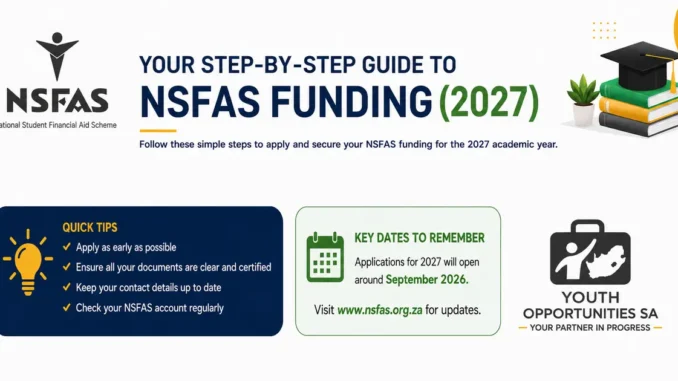
Youth Opportunities SA / Student Funding Guide
Alternative option for funding education is Possible – Here’s How
NSFAS Explained for Matrics / those who have completed Matric – Your Complete Guide to Paying for University
You’ve worked hard for your matric. Now the question is: how do you actually afford university? NSFAS might cover everything – tuition, accommodation, food, transport, and books. Here’s exactly how it works and what you need to do.
📅 Updated June 2026👤 Youth Opportunities SA⏱ 7 min read
📖 What NSFAS covers
✅ Do you qualify?
📄 Documents you need
📅 When to apply
🚀Step-by-step process
Start Here
What Is NSFAS and Could It Pay for Your Entire Degree?
NSFAS – the National Student Financial Aid Scheme – is the South African government’s bursary programme for students who cannot afford university or TVET college on their own. It is not a loan. It does not need to be paid back if you pass.
Every year, hundreds of thousands of South Africans use NSFAS to study at public universities and TVET colleges across the country – from UCT and Wits to local colleges in every province. If your family earns below a certain amount, there is a very real chance NSFAS can cover your studies entirely.
Here’s the most important thing to understand: NSFAS does not just pay your tuition. It also covers where you sleep, what you eat, how you get to campus, and the textbooks you study from. For 2026, over 609,000 students were approved – and the scheme is expected to grow further in 2027.
🎓 Not a loan – a bursary
Unlike a student loan (which you must repay with interest), a NSFAS bursary converts to zero debt as long as you pass your year. If you fail a year, NSFAS may fund one repeat. This makes it one of the most generous student funding options in the country.
The Money Breakdown
What Does NSFAS Actually Pay For?
This is the part most matrics don’t know: NSFAS is not just for tuition. Depending on your situation, it can cover virtually your entire cost of studying. Here’s a breakdown of every allowance available for university students in 2026:
🏫 Tuition – Full cost
Paid directly to your institution. Covers your full degree fees at any public university or TVET college.
🏠 Accommodation – Up to R45,000/yr
For university students in on-campus or accredited private accommodation.
🍽️ Living / Food – R1,650/month
A monthly allowance for food, toiletries, and personal expenses throughout the academic year.
🚌 Transport – Up to R7,500/yr
For students who commute from home or off-campus accommodation (within 40km of campus).
📚 Books & Materials – Up to R5,200/yr
A once-off annual allowance to cover textbooks and essential study materials.
🧴 Personal Care Up to R2,900/yr
For students in catered residences. Covers incidental personal expenses.
⚠️ Important: TVET students get different amounts
If you’re going to a TVET college, accommodation allowances differ by location: R24,000/year in urban areas, R18,900 in peri-urban areas, and R15,750 in rural areas. Transport and book allowances also apply. Ask your college’s financial aid office for the exact figures that apply to you.
In 2026, NSFAS issued the first upfront payment on 1 February, covering the full book allowance plus one month of accommodation, living, personal care, and transport allowances. Thereafter, monthly payments are made around the 29th of each month, directly into students’ bank accounts.
Check Your Eligibility
Do You Qualify for NSFAS? Here Are the 4 Requirements
Most Grade 12 leavers who plan to study at a public university or TVET college will qualify – especially if their family earns less than R350,000 per year. Check these four requirements:
- South African Citizen or Permanent Resident
You must have a valid South African ID (green ID book or smart card). Foreign students and those with refugee documents do not qualify.
2. Household Income Below R350,000/year
This is the combined income of everyone in your household. If your family receives SASSA grants, you automatically pass this test. The limit is R600,000 if you have a disability.
3. Registered (or Applying) at a Public Institution
NSFAS only funds public universities and public TVET colleges. Private colleges and institutions are not eligible.
4. First Undergraduate Qualification
NSFAS funds your first degree or diploma. If you already have a degree, you generally won’t qualify again. Postgraduate studies are not covered under standard NSFAS.
💡 Good news for SASSA households
If your family receives any SASSA grant (child support, old age grant, disability grant, etc.), you automatically qualify on the income test and do not need to submit as many financial documents. Still complete the full application, but the process is simpler for you.
Timing Is Everything
When Should You Start – and When Is the Deadline?
The single biggest mistake matrics make is waiting until after results to start the NSFAS process. Applications open in September – before your exams, before your results, even before you know which university you’ll attend.
Here’s the annual NSFAS calendar, based on patterns from recent years. Use this to plan your 2027 application now:
June – Aug
Prepare your documents 🗂️
Get certified copies of your ID, your parents’/guardians’ IDs, and proof of income. Don’t leave this for the last minute – certified documents from SAPS can take days.
~Sep 15
NSFAS application window opens 🟢
This is when you can officially apply on the myNSFAS portal (my.nsfas.org.za). Applications are expected to open around 15 September 2027 – watch for the official announcement.
Oct – Nov
Write matric exams ✏️
Apply for NSFAS before your exams – you don’t need your results yet. Applying early reduces stress and means you’re not rushing at the deadline.
~Nov 15
Application deadline ⚠️
Based on previous years, the NSFAS application window closes around 15 November. Miss this and you may have to wait an entire year. Do not miss this date.
~Dec 15
Matric results released 🎉
You get your results. If you applied for NSFAS already, you’re ahead of the game. Now focus on accepting your university offer and completing your registration.
Jan–Feb
NSFAS funding decisions released ✅
NSFAS begins releasing 2027 funding outcomes. Check your status on the portal. If provisionally funded, complete your registration at your institution quickly.
~Feb 1
First NSFAS payment 💳
NSFAS issues the first upfront payment covering your book allowance and first month of allowances — directly into your bank account.
Be Prepared
Documents You’ll Need to Apply
Incomplete applications are one of the most common reasons students get stuck – in 2026, over 218,000 applications were delayed because documents were missing. Get these together before the window opens:
- Your South African ID or birth certificate Certified copy only. A driver’s license or affidavit is not accepted. Get your ID certified at SAPS (police station) for free.
- Parent/guardian ID documents Certified copies of IDs for everyone in your household who earns income.
- Proof of household income 3 months’ payslips for each working household member, OR a SASSA grant letter, OR an unemployment affidavit if parents are not employed.
- Your latest school results (Grade 11) Your most recent academic transcript or report card. Matric results are not required to apply – they come later.
- NSFAS Consent Form Downloaded from the portal and signed by you and your parents/guardians. This allows NSFAS to verify your details with SARS, Home Affairs, and SASSA. Non-SASSA applicants must complete this.
- Valid cellphone number and email address You need a personal phone number – you cannot share one with another applicant. This is used for OTP verification and all NSFAS communication.
- Your own bank account (for receiving payments) Since 2024, NSFAS pays allowances directly to students. You need a South African bank account in your name – Capitec, FNB, ABSA, Nedbank, Standard Bank, TymeBank, and African Bank are all accepted.
💡 Pro tip: do this before September
Getting documents certified takes time. Visit your nearest SAPS station in July or August to certify your ID and your parents’ IDs. It’s free, but lines can be long — don’t leave it to the week the application opens.
Step-by-Step
How to Actually Apply: The 6-Step Process
- Go to the official NSFAS portal
Visit my.nsfas.org.za – the only official portal.
2. Register as a new applicant
Enter your SA ID number, personal cellphone number, and email address. Verify your account with the OTP sent to your phone. Use contact details that belong to you – you cannot share a number with another applicant.
3. Complete the application form
Fill in all personal details exactly as they appear on your ID. You’ll also choose up to 3 institutions and 3 fields of study — this is not a ranking, it just lets NSFAS share your funding information with every institution you’ve applied to.⏱ Allow about 1 hour if you have all documents ready
4. Sign and upload the consent form
Download the NSFAS Consent Form from the portal. All household members must sign it. Upload it along with your certified ID, proof of income, and school results as clear PDFs or JPGs.
5. Submit and save your reference number
Once you submit, screenshot or write down your application reference number. This is your proof of application. Track your status weekly through the portal.📸 Screenshot the confirmation page!
6. Register at your institution once funded
When your NSFAS status changes to “Provisionally Funded” or “Funded,” register at your institution immediately. NSFAS funding only activates once you have a confirmed place. You have one year from approval to register.
Clearing Up the Confusion
5 NSFAS Myths That Stop Students From Applying
There is a lot of misinformation about NSFAS on social media and in school hallways. Here is the truth:
MYTH “I need my matric results before I can apply.”
FACT The application opens in September – months before results. You apply using your Grade 11 results and household information.
MYTH “NSFAS is only for people who get straight A’s.”
FACT NSFAS is based on financial need, not academic achievement. There is no minimum mark requirement to apply as a first-year student.
MYTH “I have to pay NSFAS back when I graduate.”
FACT NSFAS is a bursary, not a loan. If you pass, you owe nothing. The “bursary-to-loan” conversion applied in older schemes – current NSFAS does not work that way.
MYTH “My parents work, so I won’t qualify.”
FACT The income limit is R350,000 combined household income per year — not per person. Many households with working parents still qualify, especially larger families.
MYTH “Someone on WhatsApp can apply for me for R200.”
FACT Applying for NSFAS is completely free at my.nsfas.org.za. Anyone charging you a fee to apply is running a scam. Report them to NSFAS directly.
After You Apply
Understanding Your NSFAS Application Status
Once you’ve submitted, log in weekly to check your status. Here’s what each status means:
| Status | What It Means | What You Must Do |
|---|---|---|
| Application Submitted | Received and in queue – no action needed yet | Wait and check back weekly |
| Under Review / Verification | Being checked against Home Affairs, SARS, SASSA databases | Make sure your documents are correctly uploaded |
| Incomplete | A required document is missing or unclear | Log in immediately and upload what’s missing |
| Provisionally Funded | You’ve passed the initial checks – good news! | Register at your institution as soon as possible |
| Funded | Confirmed – NSFAS will pay your tuition and allowances | Ensure your bank details are correct on the portal |
| Rejected | Application unsuccessful (a reason will be shown) | Check the reason and submit an appeal with supporting documents |
⚠️ “Incomplete” is the most fixable status
In 2026, 218,043 applications were stuck as “incomplete.” Most of these could have been resolved within days by uploading the missing document. Check your portal regularly – don’t assume “submitted” means “done.”
FAQs
Questions Matrics Ask Most
Q Can I apply for NSFAS before I know which university I’m going to?
Yes – and you should. You choose up to 3 institutions during the application. It doesn’t matter which one accepts you; NSFAS will share your funding status with all of them. You don’t need to have a confirmed place to apply.
Q What if my family earns just above R350,000? Is there anything else?
NSFAS won’t cover you, but you’re not out of options. Many universities offer their own bursaries and financial aid for the “missing middle” – students who earn too much for NSFAS but too little to afford fees. Contact your university’s financial aid office and search for private bursaries and corporate scholarships in your field of study.
Q Does NSFAS cover TVET colleges, or only universities?
Both. NSFAS funds students at public TVET colleges as well as public universities. The allowance amounts differ slightly, but tuition, accommodation, transport, and book allowances all apply.
Q What happens if I fail a module or fail my year?
NSFAS generally allows one repeat year — what is known as “N+1” funding. This means if your qualification takes 3 years, NSFAS will fund you for up to 4 years. If you fail more than that, you may lose funding. Passing is the best way to protect your NSFAS.
Q I was rejected. Can I appeal?
Yes. The appeals window opens as soon as outcomes are communicated. Log in to your myNSFAS portal, check the stated reason for rejection, and submit a formal appeal with supporting documentation (payslips, SASSA letters, medical reports, death certificates, or whatever is relevant to your situation). Appeals can be successful — don’t give up after one rejection.
Q Is there a way to get help with the application?
Yes. Youth Opportunities SA offers application assistance — we help you understand what you qualify for, prepare your documents, and submit a complete, accurate application. Our packages start from R99. Reach out via WhatsApp or our website to find out how we can help.
“This is the gateway through which hundreds of thousands of young people — especially from working-class and poor households — will be able to realise their dreams of studying at a university or TVET college.”— Minister Buti Manamela, on the NSFAS 2026 application launch
Need help with your NSFAS application?
Youth Opportunities SA guides matrics through every step – from document prep to submission. Our team makes sure your application is complete, correct, and submitted on time.
Get Application Help →Go to myNSFAS Portal
Youth Opportunities SA · Helping South African youth access education and opportunity
This guide is for informational purposes. For official NSFAS decisions and the most current figures, always check nsfas.org.za and the myNSFAS portal directly.
Leave a Reply