
If you sat the May/June 2026 (matric) rewrite exams, the papers concluded in June 2026 and you’re now in the waiting period before results are released. This guide covers when to expect your results, how to check them, and most importantly exactly what to do next whether you pass, improve your symbol, or need to try again.
When Will May/June 2026 Results Be Released?
The Department of Basic Education (DBE) has not yet published an exact release date for the May/June 2026 rewrite results. Based on the pattern from previous rewrite cycles, results are typically released roughly six to eight weeks after the exams conclude, which points to a release window around August 2026. Keep checking the official DBE website and your provincial education department for the confirmed date – we’ll update this article as soon as it’s announced.
How to Check Your Results
- At your school or exam centre – the most reliable method, and where your official Statement of Results is issued.
- DBE website – using your examination number once results go live.
- SMS or USSD service – details are published by DBE closer to the release date.
Keep your examination number and ID number ready – you’ll need both to check your results and to use them for any application afterward.
If You Passed or Improved Your Symbol
Good news: your May/June NSC results carry exactly the same weight as Final results. They are officially recognised by every South African university, university of technology, and TVET college for admission purposes.
Your immediate next steps
- Check university application deadlines. Several 2027 intake applications are still open, though competitive programmes like Medicine, Health Sciences, and Engineering often close earlier – some as soon as 31 July 2026. Don’t assume you have until September.
- Apply to NSFAS. NSFAS applications for the 2027 academic year are expected to open around 1 September 2026 and close around 21 January 2027. Get your documents (certified ID, proof of household income, consent form) ready now so you’re not scrambling in September.
- Consider TVET colleges and learnerships if a university seat isn’t realistic this cycle – both accept improved NSC results and often have more flexible intake windows than universities.
Remember: Your Statement of Results is valid for applications – you don’t need the final printed certificate to apply to universities, NSFAS, or learnerships.
If You Still Didn’t Pass or Meet the Requirements
This is not the end of the road – thousands of South African students have needed more than one attempt at matric and gone on to build solid careers. Here are your realistic options:
1. Register for the November 2026 NSC exam
You can register to rewrite outstanding or unsuccessful subjects in the November 2026 sitting. Registration typically closes around March of the exam year, so don’t delay once results are out – contact your school or district education office immediately.
2. Full-time school repeater
If you’re under 21, you can re-enrol at a school and repeat Grade 12 in full, including all seven subjects and School-Based Assessment (SBA) requirements.
3. Part-time repeater at a Public Adult Education Centre
Redo specific outstanding subjects flexibly, alongside work or other commitments.
4. Senior Certificate (SC) route
If you’re 21 or older, the Senior Certificate is a separate school-leaving qualification for adults, carrying equal weight to the NSC for most employment and tertiary purposes. SC candidates can only write in the May/June sitting, not November.
5. TVET college – a practical, job-focused path
South Africa has 50 public TVET colleges offering vocational qualifications that lead directly into artisan trades, technical careers, and learnerships – often without needing a full NSC pass.
Your NSC and your Senior Certificate carry equal weight for most jobs and further study. Focus on the fastest realistic path to a qualification, not on repeating a route that isn’t working for your situation.
6. Bridging Programmes in Universities
These are programmes designed to assist you meet minimum university admission requirements for your desirable degree, these may take 12 months to complete and then enter into a formal degree or diploma after completion.
Key Dates at a Glance
| Milestone | Date |
|---|---|
| May/June 2026 exams concluded | End of June 2026 |
| Results expected (unconfirmed) | ~August 2026 |
| University 2027 applications – general deadline | Varies by institution, mostly Jun – Sep 2026 |
| University 2027 applications – Health Sciences/Medicine | As early as 30 June or July 2026 |
| NSFAS 2027 applications open (expected) | ~1 September 2026 |
| NSFAS 2027 applications close (expected) | ~21 January 2027 |
| November 2026 NSC exam registration | Opens after results |
Frequently Asked Questions
Can I use my May/June results to apply to university?
Yes. May/June NSC results are officially recognised by all South African universities and TVET colleges for the same academic year’s applications as November results.
Are the May/June papers harder than the November papers?
No. Both sittings are set to the same standard and moderated by the same Umalusi processes, so the level of difficulty is equivalent.
Can I register for the May/June exam again next year?
Yes, if you remain eligible – but if you’re a Senior Certificate candidate, you may only write in the May/June sitting, not November.
Do I need my final printed certificate before I apply for anything?
No. Your official Statement of Results from your school or exam centre is sufficient for university, TVET, NSFAS, and most learnership applications.
Fraud warning: Never pay anyone claiming they can “fast-track,” “guarantee,” or “upgrade” your matric results, NSFAS approval, or university placement. These are scams. All legitimate results, registrations, and funding applications go only through the official DBE, university, and NSFAS platforms – never through WhatsApp agents or third parties requesting payment.
Need help with your next application?
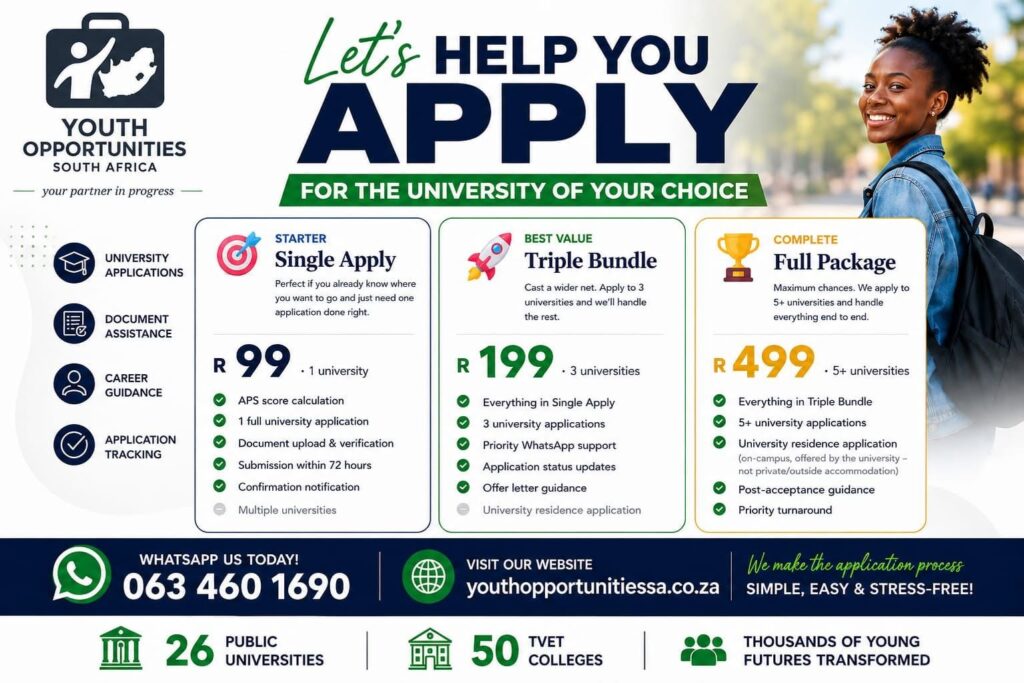
Youth Opportunities SA offers affordable university application assistance for students moving forward after their results – from single applications to full application packages.
Leave a Reply